
My article, Dismond, Bearden, and Perry: Prominent Soceity and Gossip Columnists Who Defined the Harlem Renaissance, appears in Journalism History, Volume 51, Issue 4, pages 348-368.
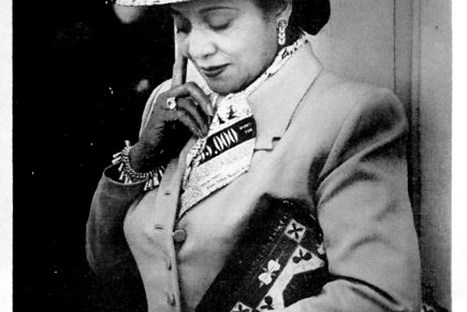

My article, Dismond, Bearden, and Perry: Prominent Soceity and Gossip Columnists Who Defined the Harlem Renaissance, appears in Journalism History, Volume 51, Issue 4, pages 348-368.
Superfine: Tailoring Black Style and the Harlem Renaissance
Bonjour,
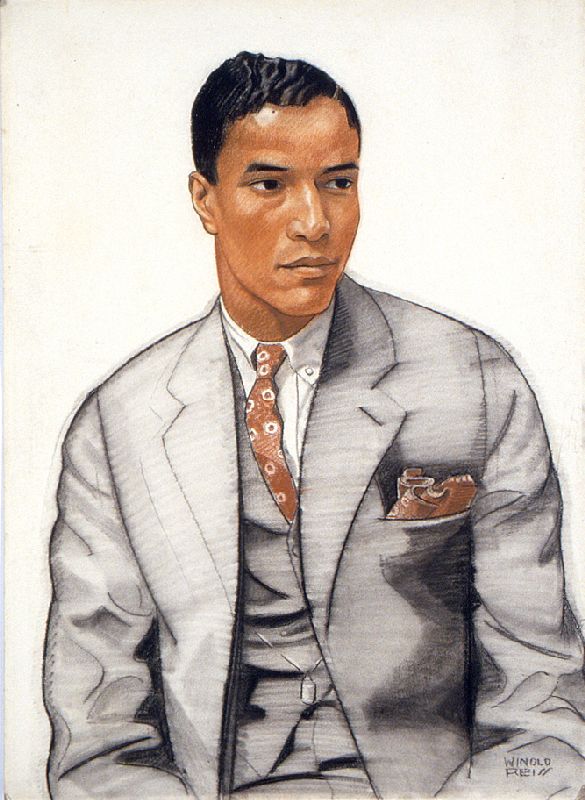
Winold Reiss’ 1924 portrait of Harold Jackman entitled A College Lad was featured in the Metropolitan Musuem’s 2025 exhibit Superfine: Tailoring Black Style. As Jackman’s biographer, I am unsure if I would classify him as a dandy. The mulatto dandy has been around since slavery. Yet Harold Jackman was not a descendant of slaves. He wasn’t even born in the United States. Too often Jackman has been objectified and deemed shallow because of his physical appearance. I am very happy to see that he was included in the Respectability section of the exhibit. Mr. Jackman was well known for his sense of style. While he didn’t have a lot of money, he managed to look well dressed. Thus it is not surprising that, in addition to being one of the first Black male models, Jackman’s image appears in many works of the Harlem Renaissance.
A College Lad is a portrait of a well educated and well dressed young man. The visible Phi Beta Kappa key signals his academic achievement and his three piece suit emits elegance. The question that has guided my research remains. Why was a biracial man born in England chosen to represent the New Negro? The answer will be found in my biography The Best Man: Harold Jackman and the Harlem Renaissance.
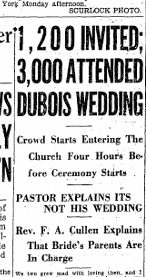
The better question is who didn’t attend the wedding. Countee and Dr. DuBois worked on the guest list for months. 1,200 were invited to the ceremony with a smaller number attended the reception. A problem arose when the entire congregation of Salem Methodist Episcopal Church assumed that they were invited.
The Harold Jackman Countee Cullen Memorial Collection, located at Clark Atlanta University, is Mr. Jackman’s greatest legacy. After giving invaluable assistance to Carl Van Vechten when he established the James Weldon Johnson Memorial Collection at Yale, Harold Jackman decided in 1942 that there should be an archive related to Negro culture at an historically Black institution. The Harold Jackman Collection was born. After Countee Cullen’s death in 1946, the title of the collection was changed to the Countee Cullen Memorial Collection.
Holdings of the collection include correspondence from Langston Hughes, Carl Van Vechten, and Countee Cullen.
 The Best Man: Harold Jackman and the Harlem Renaissance